What debt yield measures
Debt yield is net operating income divided by the loan amount: the unlevered return a lender would earn if it foreclosed and took the asset over on day one. Unlike coverage and leverage tests, it depends on nothing about the financing — the interest rate, the amortization, the appraised value, and the cap rate all drop out. It is pure operating income measured against loan dollars, which is exactly why lenders trust it: the test measures the property on its own, with the deal structure stripped away.
The debt yield formula
Debt yield = net operating income ÷ loan amount, stated as a percentage. Rearranged, it tells you the largest loan a debt-yield floor will permit:
- The yield. $1,000,000 NOI ÷ $12,500,000 loan = an 8.0% debt yield.
- The max loan. Maximum loan = NOI ÷ minimum debt yield. At an 8% floor, $1,000,000 of NOI supports at most a $12,500,000 loan.
A worked example
Take a property with $1,000,000 of underwritten NOI. The debt-yield floor sets the loan ceiling, and the ceiling moves as the floor changes:
Debt yield sizes the loan — $1,000,000 NOI, illustrative
Three inputs are missing from that table: the interest rate, the term, and the property value. None of them enters the calculation, which is the whole point. A lender can’t manufacture a bigger loan with a lower rate or a friendlier appraisal.
Why lenders use it, and what a good number is
DSCR moves with the interest rate and amortization; LTV moves with the appraisal and the cap rate. Both can be flattered by an interest-only period, a low teaser rate, or an aggressive valuation. After 2008, lenders wanted a test that couldn’t be gamed that way, and debt yield is it. Most stabilized multifamily lenders set a minimum somewhere around 8–10%: agency and CMBS lenders often anchor near the lower end for strong assets, bridge lenders demand more. A debt yield below the floor means the loan is simply too large for the income, no matter what LTV or DSCR say.
Debt yield vs cap rate, DSCR, and LTV
- vs cap rate. Both divide NOI by a dollar figure, but cap rate uses property value and debt yield uses the loan amount. Because the loan is smaller than the value, debt yield is always the higher number on the same NOI.
- vs DSCR. DSCR compares NOI to the actual mortgage payment, so it depends on rate and amortization. Debt yield ignores the payment entirely. A deal can clear DSCR on interest-only debt yet fail the debt-yield floor.
- vs LTV. LTV caps the loan as a fraction of value; debt yield caps it as a multiple of income. On low-cap-rate assets, where value is high relative to NOI, the debt-yield floor usually binds first, holding proceeds below what LTV alone would allow.
How it sizes the loan
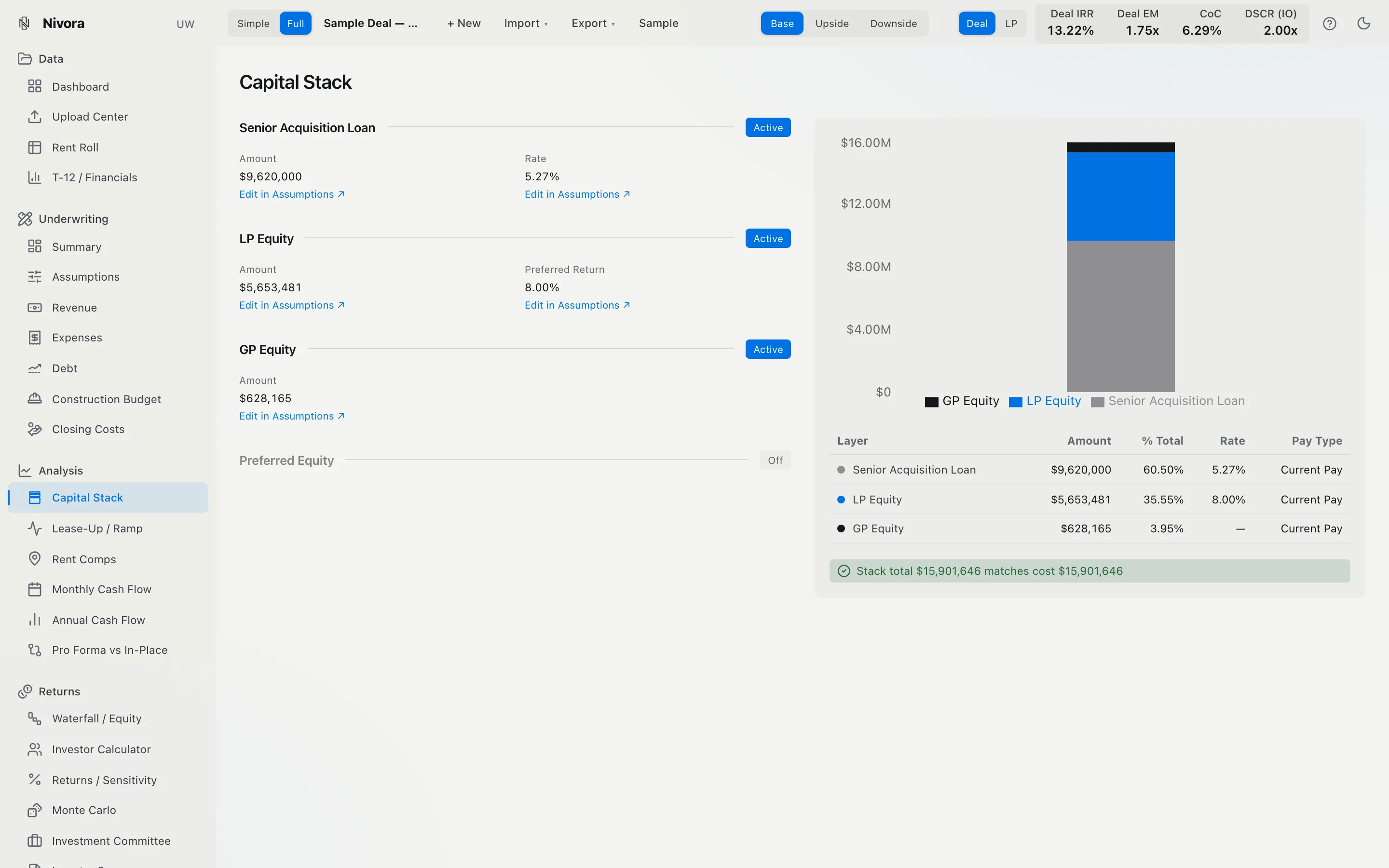
A loan is sized by the most binding of three tests: loan-to-value, debt-service coverage, and the debt-yield floor. The smallest of the three governs. This is exactly what Nivora runs on every deal: LTV, DSCR, and debt yield are computed together, and the constraint that produces the smallest loan is the one that sizes it, so the proceeds you see are the proceeds a lender will actually fund. Try it on the free loan sizing calculator.
Frequently asked questions
What is debt yield?
Debt yield is a property’s net operating income divided by the loan amount: the unlevered return a lender would earn if it foreclosed and took over the asset on day one. It is the one loan-sizing test that does not depend on the interest rate, the amortization schedule, or the cap rate, which is exactly why lenders lean on it. The test measures the property alone.
What is the debt yield formula?
Debt yield = net operating income ÷ loan amount, expressed as a percentage. For example, $1,000,000 of NOI on a $12,500,000 loan is an 8.0% debt yield. Rearranged, the maximum loan a debt-yield floor allows is NOI ÷ minimum debt yield, so at an 8% floor, $1,000,000 of NOI supports at most a $12,500,000 loan.
What is a good debt yield?
Most stabilized multifamily lenders want a minimum debt yield somewhere around 8–10%, with agency and CMBS lenders often anchoring near the lower end for strong assets and bridge lenders demanding more. Higher is safer for the lender; a debt yield below the floor means the loan is too large for the income, regardless of what LTV or DSCR say.
Why do lenders use debt yield instead of just DSCR or LTV?
DSCR moves with the interest rate and amortization, and LTV moves with the appraised value and the cap rate; both can be flattered by cheap debt or aggressive valuations. Debt yield strips all of that out: it is NOI over loan dollars, so it cannot be gamed by a low rate, an interest-only period, or a compressed exit cap. Lenders adopted it after the 2008 cycle for exactly that reason.
What is the difference between debt yield and cap rate?
They look similar, since both divide NOI by a dollar figure, but the denominator differs. Cap rate is NOI ÷ property value; debt yield is NOI ÷ loan amount. Cap rate prices the whole asset; debt yield measures the lender’s cushion on just the debt. Because the loan is smaller than the value, debt yield is always higher than the cap rate on the same NOI.
How does debt yield size a loan?
A loan is sized by the most binding of three tests: loan-to-value, the debt-service-coverage ratio, and the debt-yield floor. Under the debt-yield test, the maximum loan is NOI ÷ minimum debt yield. Whichever of the three produces the smallest loan governs. On low-cap-rate assets the debt-yield floor often binds first, capping proceeds well below what LTV alone would allow.
What is the difference between debt yield and DSCR?
Both test whether a property can carry its debt, but DSCR compares NOI (or net cash flow) to the actual mortgage payment, so it depends on the rate and amortization. Debt yield compares NOI to the loan balance itself and ignores the payment entirely. A deal can pass DSCR on cheap, interest-only debt yet fail the debt-yield floor, which is precisely the risk debt yield is designed to catch.
Does debt yield use NOI or net cash flow?
Lenders generally compute debt yield on a stabilized NOI they have re-underwritten themselves, and some use net cash flow (NOI after replacement reserves) for a more conservative figure. Either way the point is to base the test on durable operating income, so one-time items and the seller’s optimistic pro forma are stripped out first.
See it computed live.
Every concept on this page is a number Nivora computes live: the real engine is running on a fictional 104-unit sample deal right now, no login required.