What loss to lease means
Loss to lease is the difference between a unit’s market rent (what it would lease for today) and its in-place rent (the amount the current lease actually charges). Sum that gap across every occupied unit and you have the property’s loss to lease: a measure of how far below market it is renting right now. It exists because leases are signed over a rolling twelve months while market rent keeps moving, so at any moment most of the roll is priced to some earlier month’s market.
On a value-add deal, loss to lease is the thesis. The plan is to buy a property leasing below market, then capture that gap as leases expire and renew at today’s rents. That makes loss to lease the first number to compute and the first one to distrust.
The loss to lease formula
Two equivalent ways to state it:
- Dollars. Loss to lease = market rent − in-place rent, per unit, summed across the property (or property total minus property total).
- Percent. Loss to lease % = (market rent − in-place rent) ÷ market rent.
It is a gross-revenue concept, measured at the top of the income statement before vacancy, concessions, and bad debt. That placement matters: loss to lease sits between gross potential rent and effective gross income, alongside (but separate from) those other deductions.
A worked example
Take a 104-unit property. Annualize the in-place rents from the rent roll, annualize the market rents management has marked, and subtract:
Loss to lease — 104 units, illustrative
That $132,000 is the gross rent you would add if every lease reset to the marked market rent tomorrow. In practice the reset happens lease by lease over the hold, and only if the market rent is achievable.
Loss to lease vs vacancy vs concessions
These three deductions all sit between gross potential rent and effective gross income, and they are easy to conflate. Each one is a different line:
- Loss to lease. Rent left on the table by occupied units leased below market. Closes as leases renew at market.
- Vacancy loss. Rent lost because a unit is empty. Closes by leasing the unit.
- Concessions. Rent given back to a tenant who signed (free weeks, waived fees). A pricing tool of its own, separate from the market-vs-in-place gap.
A fully occupied property can still carry large loss to lease: occupancy measures whether the units are full, while loss to lease measures whether the full units are priced to today’s market.
When loss to lease is real, and when it’s a trap
Loss to lease is only opportunity if the market rent is achievable. The management “market rent” column is a claim, and it is the single easiest input to inflate — a few dollars per unit across a few hundred units manufactures a six-figure “upside” that does not exist. Verify it before you underwrite it:
- Check the freshest signed leases. The units that just leased are the best evidence of true market rent, far better than the management mark. If new leases are signing near the in-place average, the loss-to-lease gap is a mirage.
- Pull leased comps. The useful comp is the rent a competing property actually signed, net of concessions; an asking rent is only an aspiration.
- Watch for gain to lease. If in-place rents sit above market (negative loss to lease), leases renew downward as they roll. Recent leases below the roll average are the tell.
How loss to lease flows into the deal
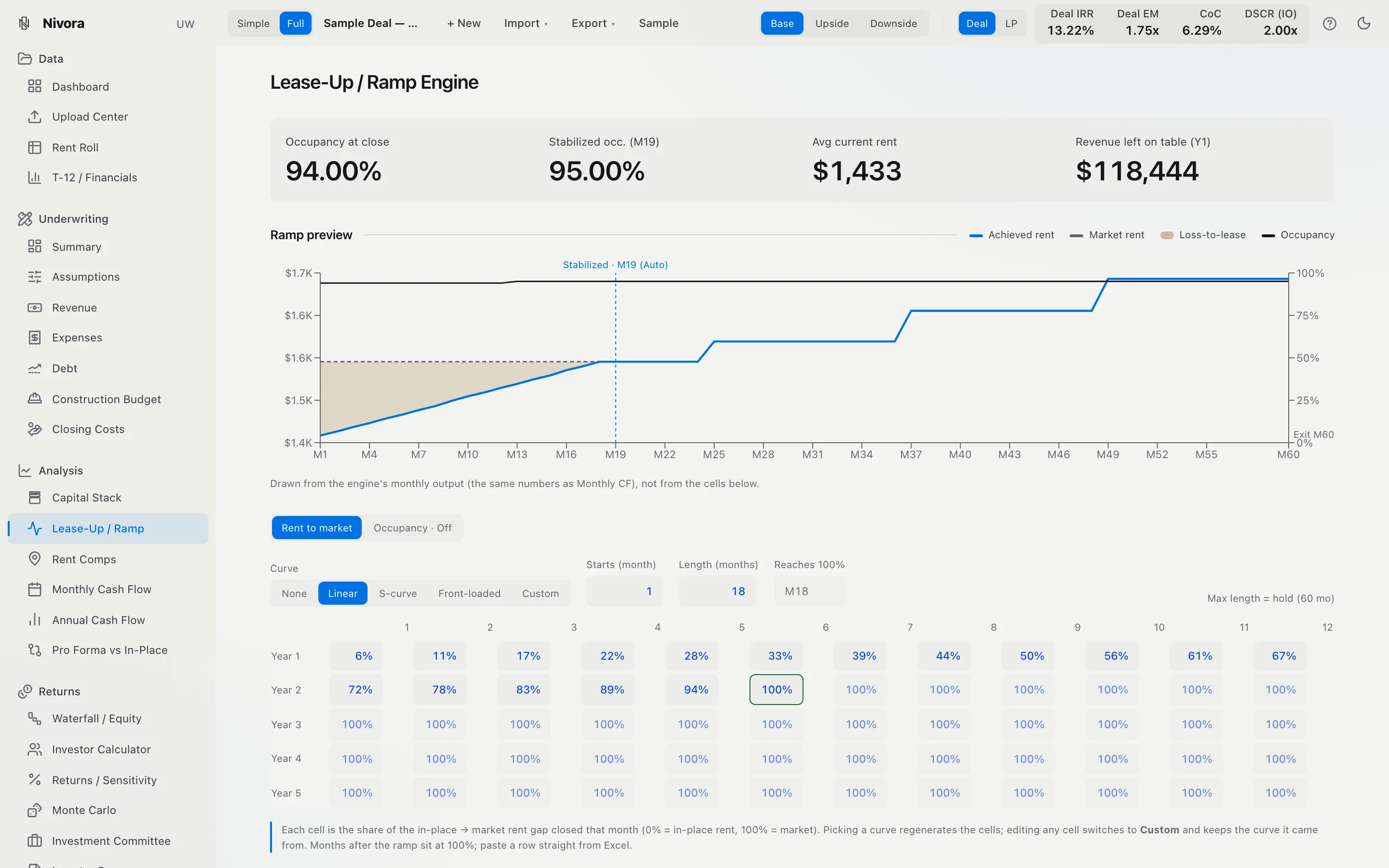
Because capturing loss to lease takes time and re-leasing, lenders and appraisers underwrite it conservatively, generally to in-place or recent (T-3) rents. A pro forma that assumes the gap closes on day one gets little credit: a deal whose returns depend on burning off loss to lease immediately will not size the same on a lender’s pencil as it does on the broker’s. The honest way to model it is a lease-up schedule that rolls units to market as they expire.
This is exactly what Nivora computes on upload: loss to lease is measured straight from the rent roll, reconciled against the T-12, and rolled into revenue as leases turn, so the upside in the model is the upside the leases can actually deliver on a schedule a lender will fund.
Frequently asked questions
What is loss to lease?
Loss to lease is the difference between a unit’s market rent and the in-place rent the current lease actually charges, summed across the property. It measures how far below market a property is renting today. On a value-add deal it is the headline of the business plan: the rent you expect to capture as leases roll to market, provided that market rent is real.
What is the loss to lease formula?
Loss to lease = market rent − in-place (actual) rent. Compute it per unit and sum, or take the property totals: annualized market rent minus annualized in-place rent. Expressed as a percentage, loss to lease = (market − in-place) ÷ market. It is a gross-revenue concept, measured before vacancy, concessions, and bad debt.
How do you calculate loss to lease from a rent roll?
Annualize the in-place rent (sum the actual lease rents × 12) and the market rent the same way, then subtract. On a 104-unit example: $1,668,000 market − $1,536,000 in-place = $132,000 of loss to lease, or about 7.9% below market. That $132,000 is the gross upside only if those market rents can actually be signed.
Is loss to lease good or bad?
Neither on its own: it is only opportunity if the market rent is achievable. Real loss to lease on a well-located asset is a mark-to-market you can capture as leases turn. But if the “market rent” column is aspirational, the same number is a trap that inflates your projected upside. Verify it against leased comps and the units that just signed before you underwrite any of it.
What is the difference between loss to lease and vacancy loss?
Loss to lease is rent left on the table by occupied units leased below market; vacancy loss is rent lost because a unit is empty. They are separate lines: a fully occupied property can still carry large loss to lease, and both sit between gross potential rent and effective gross income. Loss to lease closes as leases renew at market; vacancy closes by leasing the empty units.
What is gain to lease?
Gain to lease is negative loss to lease: in-place rents sitting above current market, usually because rents were pushed hard in a peak and the market has since softened. It is a warning sign, because as those leases roll they renew downward. Recent leases signed below the in-place average are the tell.
How do lenders and appraisers treat loss to lease?
Conservatively. Lenders and appraisers generally underwrite to in-place or recent (T-3) rents, and they give little credit to a pro forma that assumes loss to lease is fully captured on day one. Burning off loss to lease takes time and re-leasing, so a deal whose returns depend on closing the gap immediately will not size the same on a lender’s pencil as it does on the broker’s.
What is a normal loss to lease percentage?
It varies by market and lease strategy, but stabilized properties commonly run a few percent of gross potential rent (often the low single digits), simply because leases are signed over a rolling twelve months while market rent moves. A very large gap (high single digits or more) signals either genuine value-add or an aspirational market-rent assumption; either way it deserves a comp check.
See it computed live.
Every concept on this page is a number Nivora computes live: the real engine is running on a fictional 104-unit sample deal right now, no login required.